
BLOG
How Sapho Bio Tests for Peptide Potency
We correct our reference standards to the Net Peptide Content of every peptide API — so your potency result reflects exactly how much peptide is in the vial.
Jul 21, 2026
Contributors

Ali Palla
Research Scientist
Potency testing answers a deceptively simple question: How much API is in a compounded preparation?
Disclaimer:
Information provided is for educational purposes only and does not constitute regulatory or medical advice. Testing requirements and applicability depend on the specific formulation, intended use, and current USP/FDA standards. Always consult the official chapters and your quality/regulatory team.
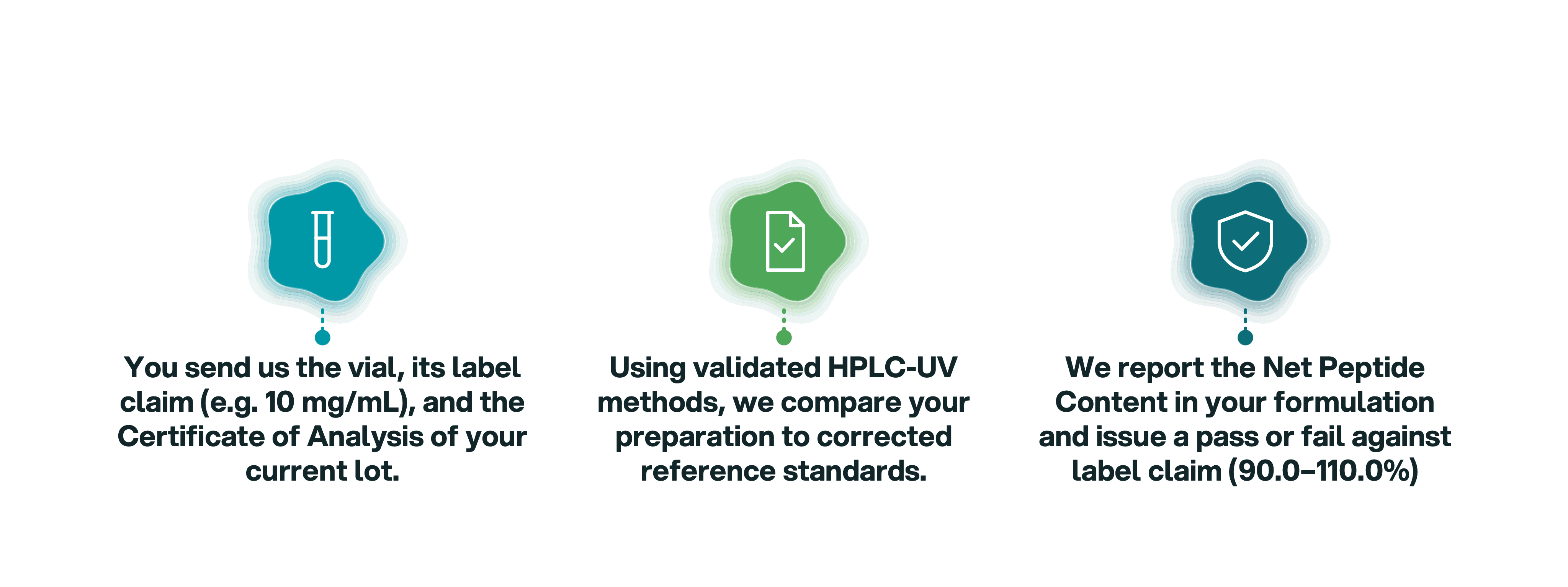
A pharmacy sends us a vial labeled 10 mg/mL of a peptide API. By measuring it against our internal reference standards using HPLC-UV (USP <621>), we then report whether it meets its label claim (90.0–110.0%). That result is only as trustworthy as the standard behind it, which is why we correct our standards to the Net Peptide Content of the API.
The Problem We Kept Seeing
A common error when compounding peptides is improperly correcting the mass of lyophilized powder using data from the Certificate of Analysis (COA). A batch of lyophilized peptide does not only contain the peptide of interest: counterion salts (such as TFA or acetate) and water can be a substantial fraction of the powder. "HPLC Purity" is usually the highest number on the COA and the easiest to reach for.
But it doesn't accurately describe all the impurities in a batch; correcting to HPLC Purity alone can miss a massive shortfall. The result is a preparation that is subpotent, even when the label was followed exactly, and a patient who is under-dosed. We design our testing to detect this problem before it reaches a patient.
What a Certificate of Analysis Tells You
A complete COA reports many values that carry different information. Three matter, and each measures something different:
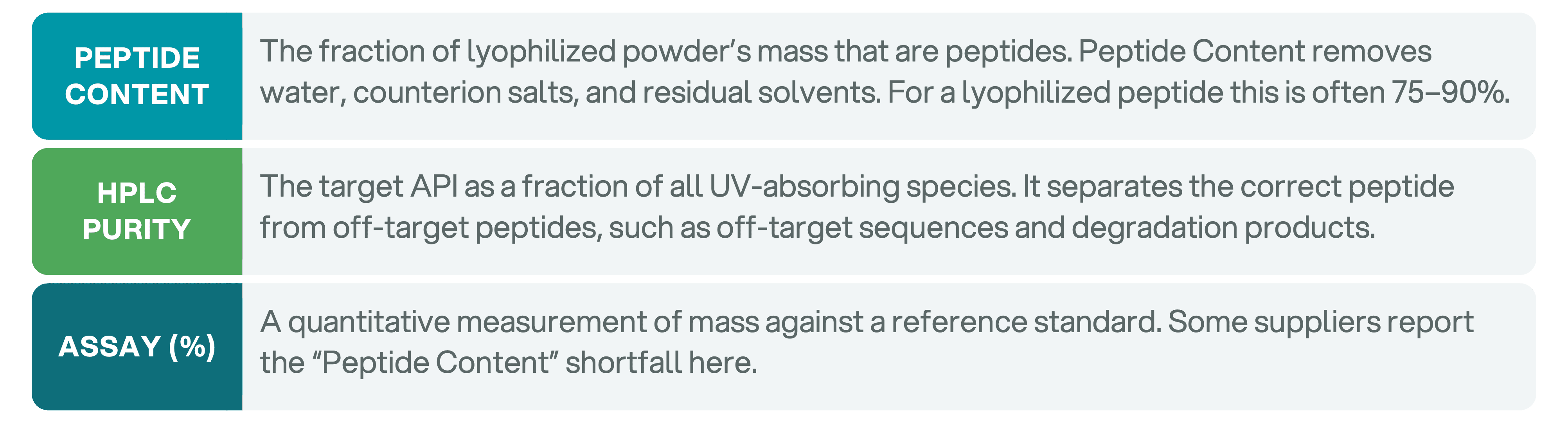
No single value is the whole story; each holds valuable information about what is actually in your product. For that reason, all of these values need to be incorporated into your corrections.
How We Determine Net Peptide Content
Here at Sapho Bio, when we prepare standards from lyophilized powder, we measure what we call the Net Peptide Content. The Net Peptide Content for a peptide API is defined as:
Net Peptide Content = Measured Mass × (Peptide Content %) × (HPLC Purity %) × (Assay %)
The Net Peptide Content represents the actual amount of peptide API in a formulation and accounts for all of the shortfalls described in a COA.
Other Benefits of using Net Peptide Content:
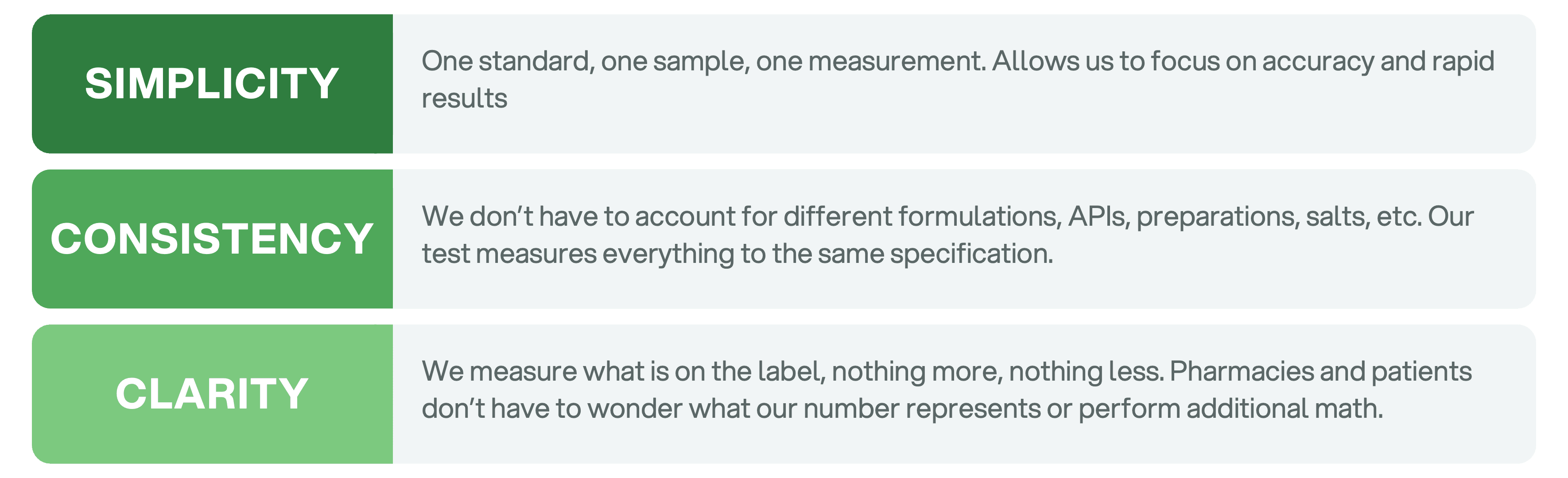
Example Calculation: A peptide standard measured at 10 mg, with an 85% Peptide Content, 98% HPLC Purity, and 99% Assay.
Net Peptide Content = 10 mg × (0.85) × (0.98) × (0.99) = 8.25 mg

That is a 17.5% gap from the label — greater than the difference between a preparation that passes and one that fails.
How Our Potency Testing Works
Further reading. Sigma-Aldrich, Peptide Sample Amount Determination; Bachem, Quality Control of Amino Acids & Peptides; AmbioPharm, What is Net Peptide Content?; Iris Biotech, Net Content and Purity.
This article is educational and does not replace your facility's quality program or professional judgment. Compounded-preparation potency expectations follow USP <795> / <797>.
Frequently Asked Questions
TALK TO A SCIENTIST
Tell us what you need tested
Whether you need testing guidance, a quote, or just have questions — we’re here. A scientist will follow up within one business day.
USP methods verified for suitability, alternatives validated
Response within one business day
No obligation — guidance and quotes welcome
For service requests, quotes, or technical questions, email our support team.
info@saphobio.com
Phone
Available Monday to Friday, 9:00 AM – 6:00 PM (Pacific Time).
Text us: +1 (929) 437-6148
Site Visit
Visits by appointment only. Please contact us to schedule.
1068 Washington St. STE B, San Carlos, CA 94070

1068 Washington St Ste B, San Carlos, CA 94070

© 2026 SAPHO BIO. All rights reserved.