
BLOG
FDA Advisory Committee Reviews Seven Peptides for 503A Compounding: Key Takeaways
The FDA's Pharmacy Compounding Advisory Committee reviewed seven peptides for the 503A bulks list on July 23-24, 2026. Here's what it recommended and what it means.
Jul 26, 2026
Contributors

Sapho Bio
Disclaimer:
Information provided is for educational purposes only and does not constitute regulatory or medical advice. Testing requirements and applicability depend on the specific formulation, intended use, and current USP/FDA standards. Always consult the official chapters and your quality/regulatory team.
What the committee recommended
Over two days, PCAC voted on seven peptide families:
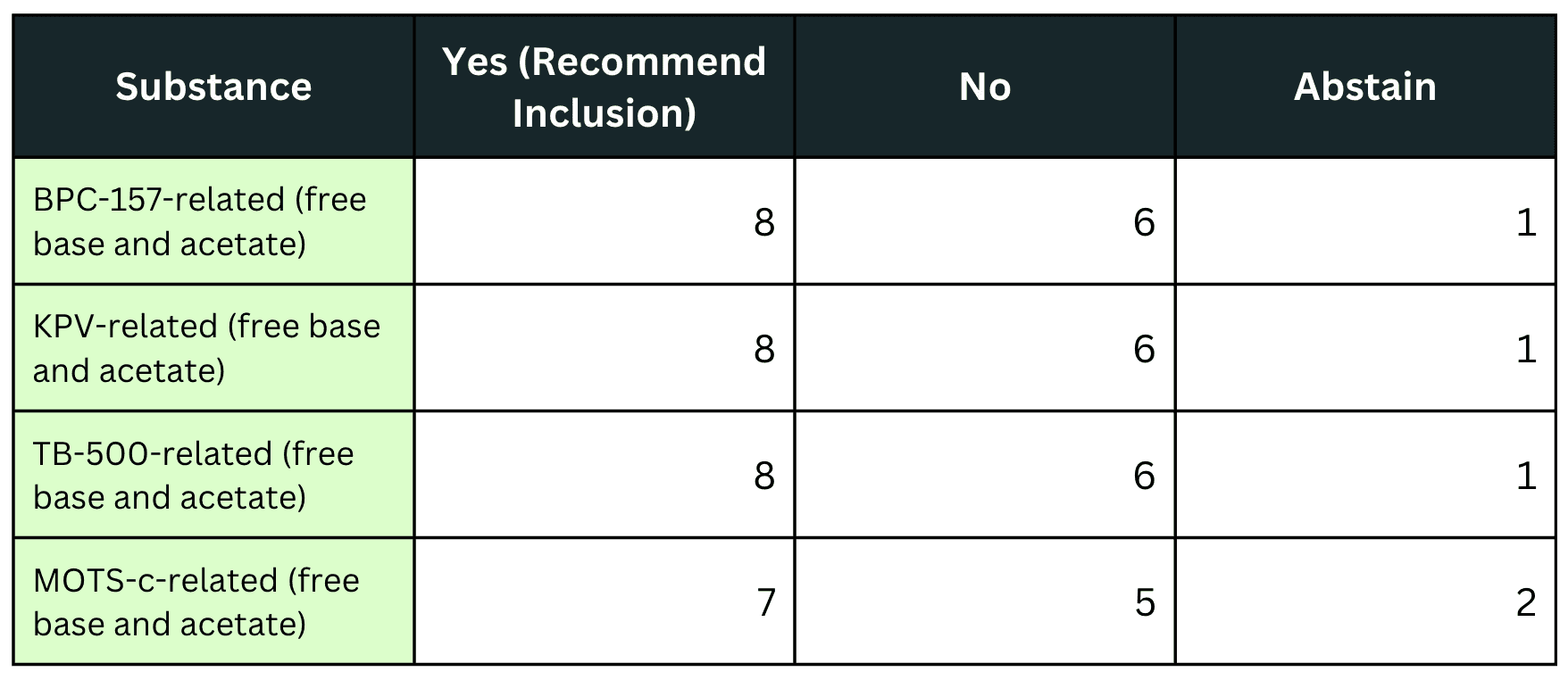
Day 1 (July 23): Majority support for including BPC-157, KPV, TB-500 (a thymosin β-4 fragment), and MOTS-c related substances.
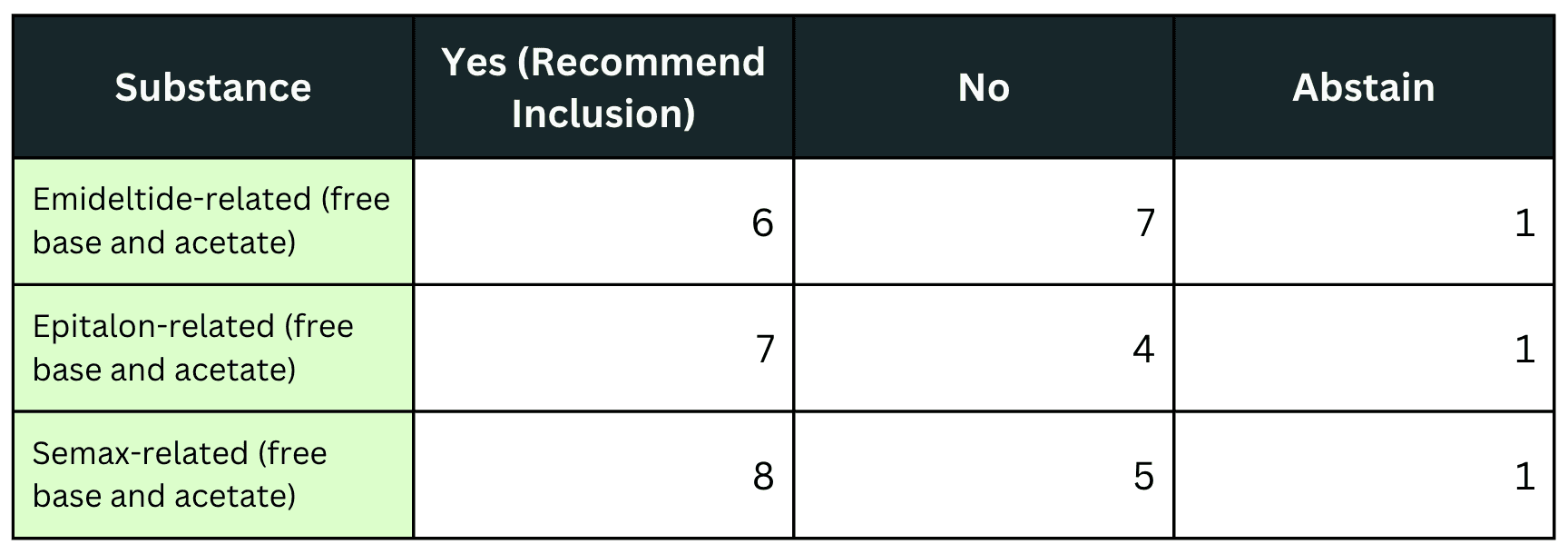
Day 2 (July 24): Support for Epitalon and Semax related substances; the committee rejected Emideltide (delta sleep-inducing peptide, or DSIP).
One critical caveat: these recommendations are non-binding. The FDA retains full authority to amend or decline them in subsequent rulemaking.
The substances reviewed
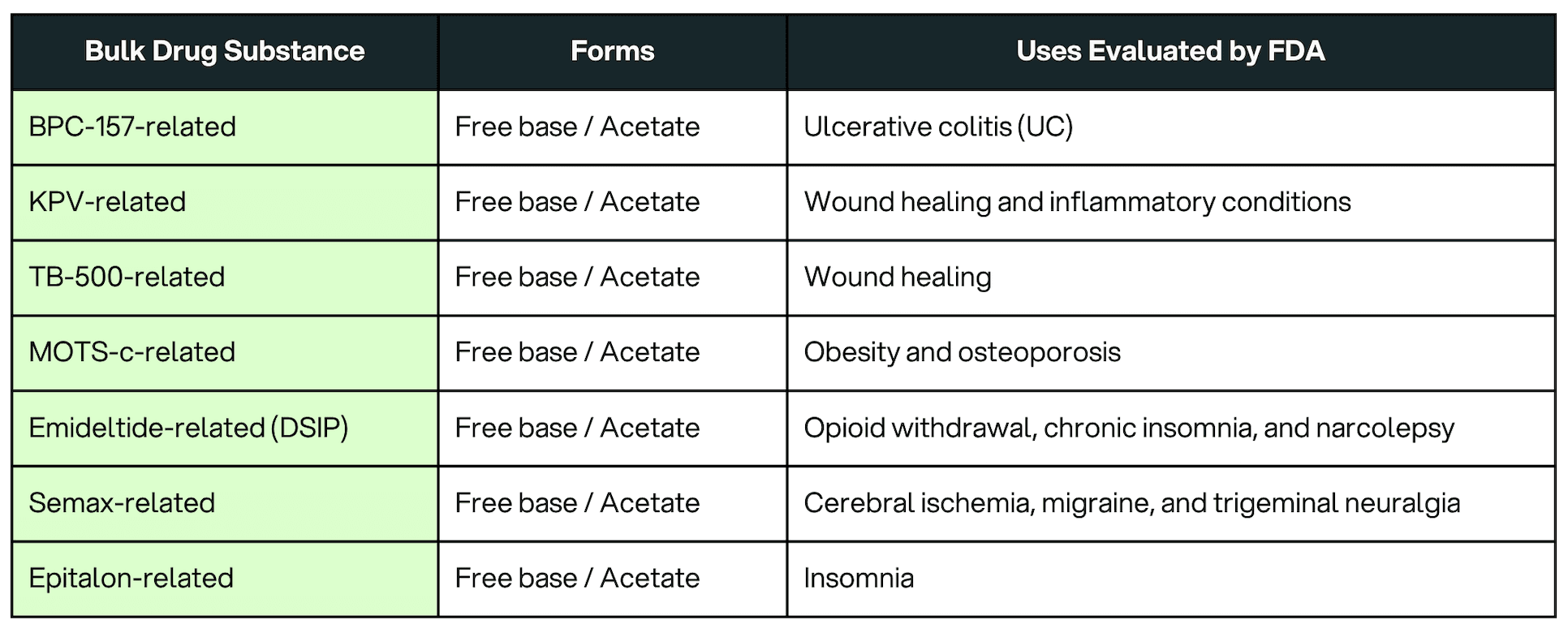
The committee evaluated seven peptide families, each in free-base and acetate forms, across a range of proposed uses:
The vote, day by day
Day 1 (July 23). The first four peptides each drew majority support for inclusion:
Day 2 (July 24). Epitalon and Semax cleared the bar; Emideltide (DSIP) did not:
The interim framework: three categories
While the bulks-list rule is being finalized, the FDA sorts nominated substances into three buckets: Category 1 (Permitted), Category 2 (Prohibited, safety risks), and Category 3 (Prohibited, insufficient data). In late 2023, the FDA had placed all seven peptides in Category 2, citing immunogenicity concerns, difficulty characterizing impurities, and limited human clinical data.
The recurring theme: characterization and data gaps
Across the substances, the committee and FDA analyses flagged the same quality and evidence issues:
No USP/NF monographs, and inconsistent naming conventions
Incomplete certificates of analysis
Insufficient data on impurities, aggregates, bioburden, and endotoxins
Thin human clinical evidence: for BPC-157, the strongest cited was a small 2005 placebo-controlled trial abstract in mild-to-moderate ulcerative colitis (n ≈ 53)
Limited nonclinical toxicity studies matching the proposed routes of administration (injectable, oral, nasal, rectal, topical)
FDA-approved alternatives already exist for the evaluated indications (for example, mesalamine, biologics, and JAK inhibitors for ulcerative colitis)
The meeting also treated free-base and acetate salt forms as distinct substances, given differences in structure, solubility, stability, and quality attributes.
The path from recommendation to placement
A favorable vote is only the first step. Here is the road from an advisory recommendation to an actual change in what pharmacies can compound:
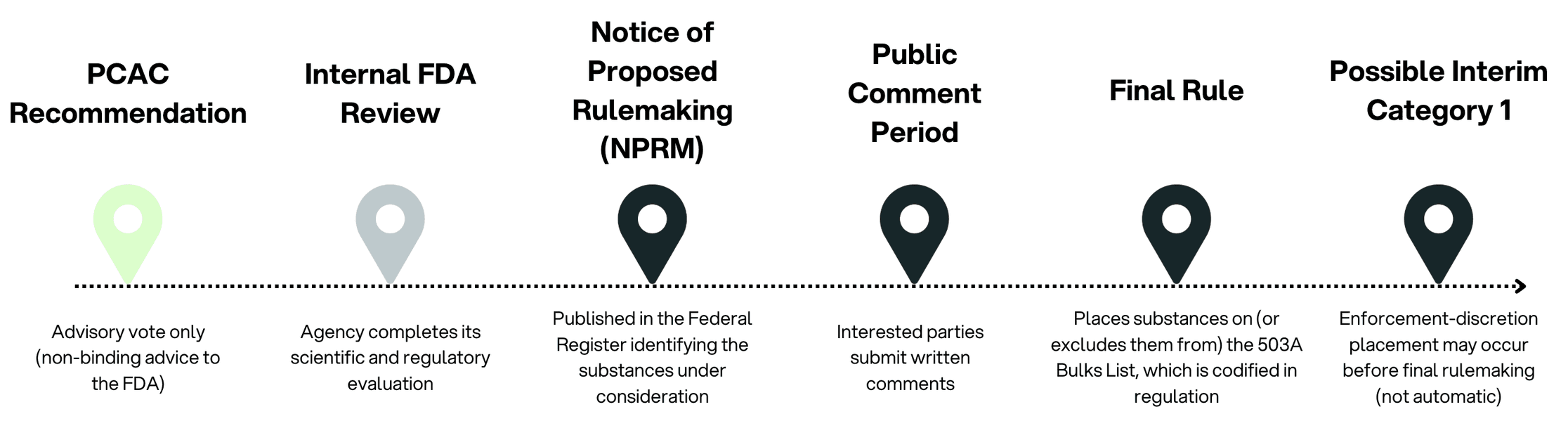
The committee's advice, FDA analyses, nominator submissions, and public comments now form the administrative record that will inform notice-and-comment rulemaking. Stakeholders can track Docket FDA-2025-N-6895 for developments.
Where things stand today
Until the FDA issues a Final Rule or a Category 1 designation, all seven peptides remain outside the authorized scope of 503A compounding. Research-use-only (RUO) material continues to circulate through research-chemical suppliers with variable third-party testing for identity, purity, residual solvents, and endotoxin. Separately, BPC-157 also remains prohibited at all times under the World Anti-Doping Agency (WADA) Prohibited List, in the S0 (non-approved substances) category.
Why characterization matters: the QC lens
If there is a through-line in the committee's concerns, it is characterization: knowing exactly what is in a compounded preparation and confirming it is safe and correctly dosed. That is the job of analytical testing. For sterile preparations, that typically means rapid sterility testing and bacterial endotoxin testing to confirm safety, alongside potency testing to confirm the labeled dose.
Testing also underpins shelf life. Well-designed stability studies let a compounder support an extended beyond-use date (BUD) with real data instead of a conservative default. As the regulatory picture around compounded preparations continues to evolve, the pharmacies and manufacturers best positioned to adapt will be those with disciplined, standards-aligned testing behind every lot.
Key takeaways
PCAC recommended 6 of 7 peptides for the 503A bulks list; it rejected Emideltide (DSIP).
The recommendations are non-binding: the FDA decides in rulemaking.
All seven peptides remain outside authorized 503A compounding until a Final Rule.
The core concerns were characterization and data: impurities, aggregates, endotoxin, and clinical evidence.
Follow Docket FDA-2025-N-6895 for updates.
References
FDA — July 23–24, 2026 Meeting of the Pharmacy Compounding Advisory Committee
FDA Briefing Document: PCAC Meeting July 23–24, 2026 (overview package)
Reuters — FDA advisers back first four of seven unapproved peptides under review
Fierce Pharma — Peptides favored on 1st day of FDA compounding adcomm
FDA — Certain Bulk Drug Substances That May Present Significant Safety Risks
FDA — Bulk Drug Substances Used in Compounding Under Section 503A
Federal Register — PCAC Notice of Meeting; Establishment of a Public Docket
RAPS — FDA considers adding a dozen peptides to its bulk drug compounding list
FDA — Interim Policy on Compounding Using Bulk Drug Substances Under Section 503A
USADA — BPC-157: Experimental Peptide Creates Risk for Athletes
Frequently Asked Questions
TALK TO A SCIENTIST
Tell us what you need tested
Whether you need testing guidance, a quote, or just have questions — we’re here. A scientist will follow up within one business day.
USP methods verified for suitability, alternatives validated
Response within one business day
No obligation — guidance and quotes welcome
For service requests, quotes, or technical questions, email our support team.
info@saphobio.com
Phone
Available Monday to Friday, 9:00 AM – 6:00 PM (Pacific Time).
Text us: +1 (929) 437-6148
Site Visit
Visits by appointment only. Please contact us to schedule.
1068 Washington St. STE B, San Carlos, CA 94070

1068 Washington St Ste B, San Carlos, CA 94070
© 2026 SAPHO BIO. All rights reserved.