
BLOG
RT-qPCR
RT-qPCR basics for pathogen RNA detection and sterility testing
Jun 2, 2026
Contributors

Santhosh Karanth
Research Scientist
Amidst the chaos of the COVID-19 pandemic, while many people were quarantined, many scientists around the world spent their days in clinical laboratories performing one technique to analyze patient nose swab samples and determine if people were infected with the RNA virus: RT-qPCR.
PCR stands for “polymerase chain reaction”, and is the gold standard nucleic acid amplification method worldwide. Nowadays, there are many PCR-based techniques. One of the most popular is quantitative or real-time PCR (qPCR), which, unlike normal PCR, measures nucleic acid amplification in samples in real time, as the reaction is on-going. Standard qPCR measures DNA; RT-qPCR measures RNA.
qPCR and RT-qPCR are used for many things, from COVID-19 diagnosis, to food safety and pathogen detection, cancer progression monitoring and even forensic analysis.
The same technology can be used for rapid sterility testing and pathogen detection in any setting. This article covers how RT-qPCR works, how it can be used to detect any living pathogen, and the workflow we follow to do so.
How RT-qPCR works
qPCR works by amplifying a piece of target DNA exponentially, using small sequences called primers to start amplification cycles. Within each reaction, molecules are added which become fluorescent when the amplification of DNA is successful. After each cycle, fluorescence is measured. Billions of copies of the target DNA can be created in a standard run of 90 minutes. This gives qPCR a very high sensitivity, even with low-input samples.
But when RNA is the molecule of interest, a previous step must be added, where an enzyme called reverse transcriptase (RT) turns the RNA into DNA. Afterwards, the qPCR can proceed normally. The combined process is called RT-qPCR.
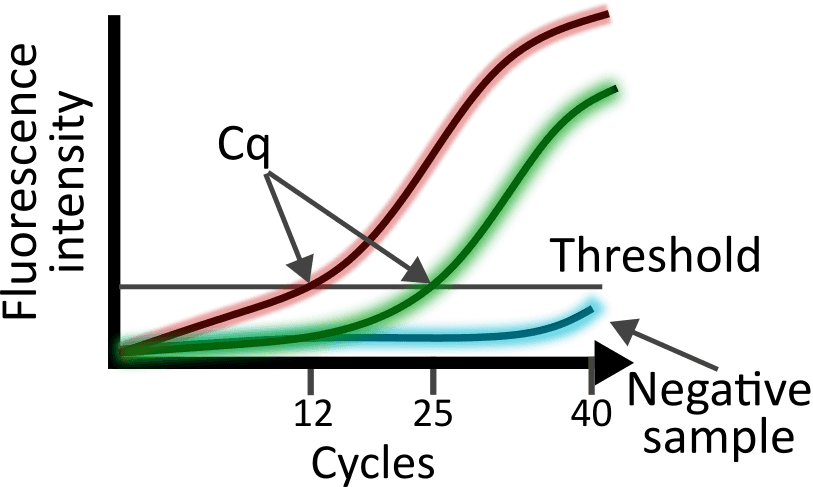
The primary output of a qPCR run is the Cq value (quantification cycle) of each sample/well (also known as Ct, or threshold cycle). This is the cycle at which the fluorescent signal first crosses a defined background threshold. A lower Cq means more starting material was present: a sample with 10,000 copies will cross the detection threshold earlier than one with 100, and thus have a lower Cq.
This allows users to compare DNA quantity between samples, and why it is named “quantitative.”
Image 1: qPCR readout showing Cq values of positive samples and a negative sample that never crosses the “threshold” value.
Ribosomal RNA as a target for pathogen detection
Inside all living cells, there are organelles called ribosomes. These are made of both ribosomal RNA (rRNA) and proteins. And rRNA is an ideal target for pathogen detection: Some regions are highly conserved across many bacterial groups, meaning that their sequence is similar in almost all bacteria, while other regions are variable and differ depending on the bacterial species being detected.
Choosing which region of rRNA to target allows users of RT-qPCR to obtain precise information about the type of organisms that the rRNA came from.
Target ribosomal RNA: 16S vs. 18S
Although every cell has rRNA, there are two main groups of ribosomes:
70S, which are smaller, and belong to bacteria and archaea.
80S, which are bigger, and found on eukaryotic cells.
Each of them has a big and small rRNA. The small rRNA of bacteria and archaea is called 16S, and the one of eukaryotes, which is a bit larger, is called 18S.
The differences are enough that targeting certain regions of the 16S rRNA will result in only detecting bacteria and archaea, which are sometimes pathogenic to humans, but it won’t detect human 18S rRNA or any other eukaryotic rRNA. This makes RT-qPCR really effective when it comes to identifying possible pathogens.
Why measure RNA instead of DNA?
But why go through the pain of using an enzyme to turn RNA to DNA and not just target pathogen DNA? The reason behind why RNA detection works better for pathogen detection is that DNA is very stable, while RNA is unstable, and will break down very quickly on its own.
This means that if there are traces of DNA from dead cells, these could still be detected with qPCR, and a false positive result could be obtained from a sample that was essentially pathogen-free. The same is not the case when measuring RNA, and the presence of RNA is much more likely to mean that there were live bacteria in the sample.
Cells also have a few copies of 16S DNA, but each one has thousands of ribosomes, and in turn of 16S rRNA. RT-qPCR can detect as little as 10 copies of DNA or RNA. This means that the presence of a single cell in a sample can be detected when measuring 16S rRNA, but that would not always be the case if DNA was the target molecule.
For sterility testing, measuring 16S rRNA determines whether viable, potentially harmful microorganisms are present, regardless of how many there may be.
The RT-qPCR workflow explained, from sample to result
We use several steps to go from your samples to detected pathogens or validated clean samples using RT-qPCR.
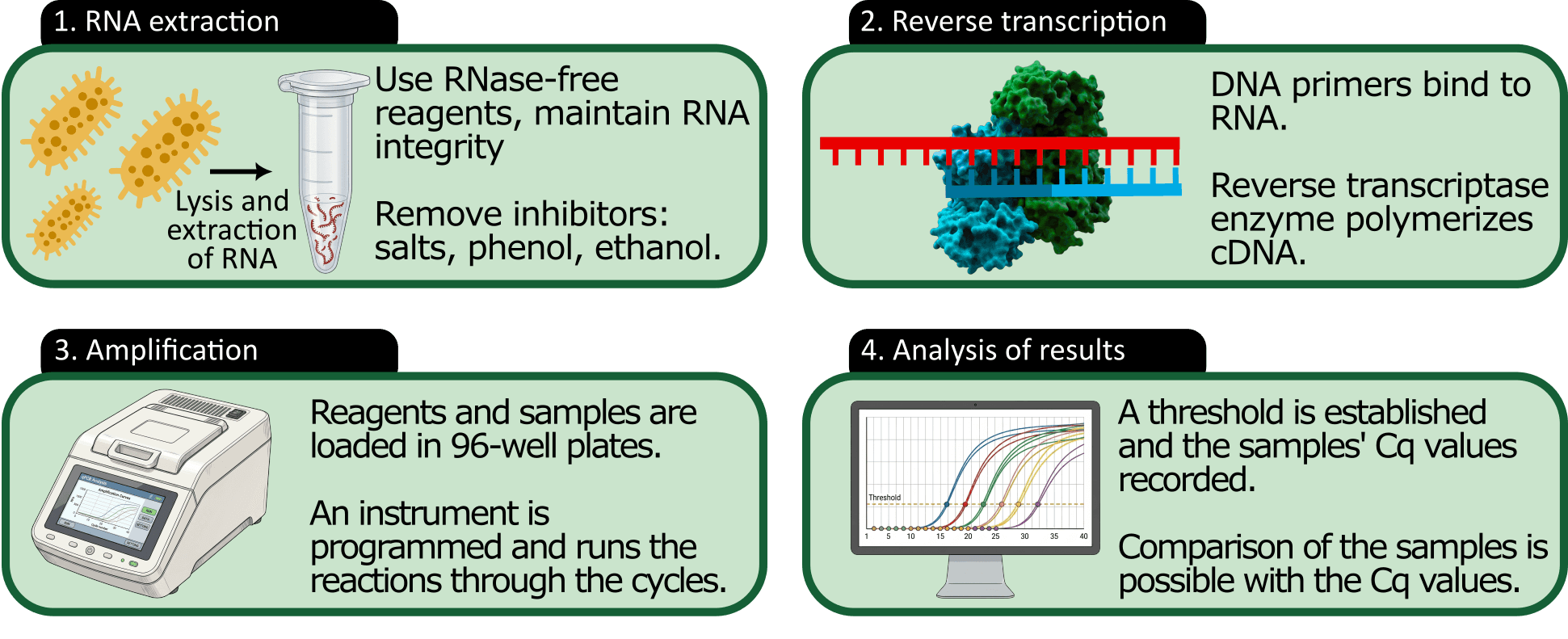
Image 2: The standard workflow for RT-qPCR.
1. RNA extraction
First, we lyse any cells present in the sample and extract the RNA. Degradation at this stage will compromise the result. The extract also needs to be free of inhibitors like residual salts or solvents, which can interfere with the enzymes in the reaction.
2. Reverse transcription
Because qPCR amplifies DNA, not RNA, the first enzymatic step copies all RNA into stable DNA. The reverse transcriptase enzyme synthesizes a complementary DNA (cDNA) strand to the RNA.
3. Amplification
We mix the cDNA template, primers targeting the 16S rRNA sequence (or any other target of choice), a thermostable polymerase, and a fluorescent reporter molecule, and other buffers and nucleotides needed for the reaction. The samples go through repeated heating and cooling cycles: heat to separate the DNA strands into ssDNA, cool to let primers bind, then extend the primers to create dsDNA. The instrument reads the fluorescence intensity of each reaction at the end of every cycle, building an amplification curve in real time.
4. Analysis of results
The final Cq values and fluorescence intensity curves can be compared. Samples that do not cross the threshold are considered negative.
RT-qPCR for sterile pharmaceutical products
Current sterility testing requires a 14-day incubation period, during which the product sits in quarantine before it can be released.
Our Rapid Sterility Testing service uses RT-qPCR on samples clients send to us, and we deliver equivalent microbial detection in under 20 hours, resulting in faster release decisions, less time in storage, and providing molecular results that remove visual detection ambiguity from the process.
We maintain rigorous and ongoing aseptic procedures and environmental monitoring, with both positive and negative controls, and the ability to carry out more sophisticated analysis as needed.
If you are interested in learning more reach out to us directly, or create an account and a rep will reach out to you directly.
TALK TO A SCIENTIST
Tell us what you need tested
Whether you need testing guidance, a quote, or just have questions — we’re here. A scientist will follow up within one business day.
USP methods verified for suitability, alternatives validated
Response within one business day
No obligation — guidance and quotes welcome
For service requests, quotes, or technical questions, email our support team.
info@saphobio.com
Phone
Available Monday to Friday, 9:00 AM – 6:00 PM (Pacific Time).
Text us: +1 (929) 437-6148
Site Visit
Visits by appointment only. Please contact us to schedule.
1068 Washington St. STE B, San Carlos, CA 94070

1068 Washington St Ste B, San Carlos, CA 94070

© 2026 SAPHO BIO. All rights reserved.