NOW OFFERING
Container Closure Integrity Testing
USP <1207> container closure integrity testing (vacuum decay) for sterile vials.
View Testing Services
Compendial standard this method is validated to.
Business days from test start to report, so schedules hold.
Vial formats supported today: 2R, 6R and 10R.

WHY YOU NEED IT
Why Container Closure Integrity Testing Matters
Prove the seal holds
A preparation stays sterile only while its container–closure system keeps microbes and gas out. USP <1207> evaluates whether the seal does that.
Deterministic leak detection
<1207> divides leak tests into deterministic and probabilistic. Vacuum decay is deterministic: objective quantitative data, without the large sample sizes.
Where <797> requires it
<797> requires it for Category 3 CSPs and for any multiple-dose CSP — once per formulation, container and fill volume, demonstrated to the end of the BUD.
OUR PROCESS
How we run this test for you
Method Development
Proving the method first
Vacuum decay is specific to the container it runs on. For a format new to us, dimensions or a single unit are usually enough to confirm a method can be developed for it.
Dimensions, or a single unit
Method Suitability
Releasing every batch
Once a method exists, we establish that it performs reliably on your specific container — which takes a set of units rather than a single sample.
Typically 15 units per study
Stability Studies
Across your stability timeline
With development and suitability done, CCIT runs inside your stability program — <797> asks for integrity demonstrated to the end of the assigned BUD.
10 units per timepoint
TECHNOLOGY
Vacuum decay finds the leaks.



01
Seal in the chamber
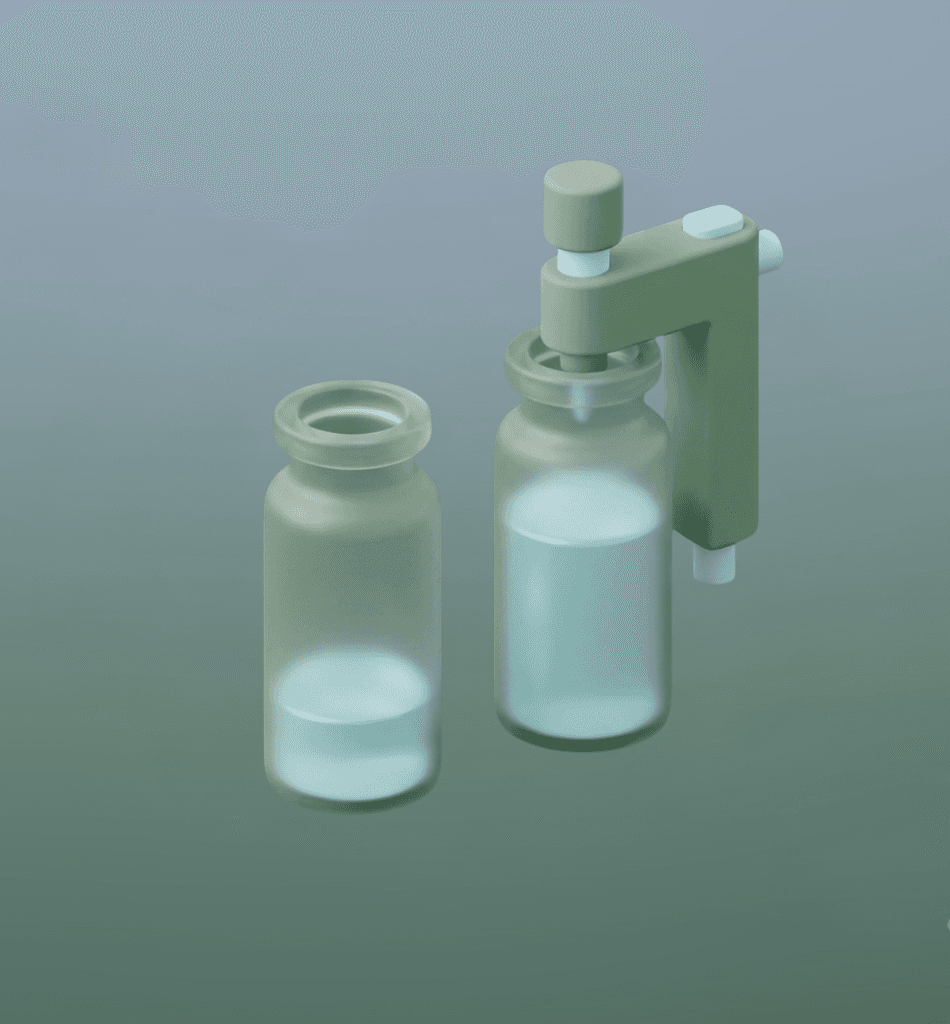
The container is placed in a format-specific chamber and a vacuum is drawn around it.
02
Monitor the decay
Pressure is tracked over time; a rise signals gas escaping through a leak in the seal.
03
Compare to the limit
The decay is measured against a validated threshold that rules out leaks large enough for microbial ingress.
OUR SERVICES
Learn About Other Services





STABILITY STUDIES
Planning a stability study?
See how this test can support a validated stability program and the data needed for extended beyond-use dating.
✓
Stability-indicating HPLC methods that separate API from degradation products
✓
Custom study designs for refrigerated, frozen and room-temperature storage conditions
✓
Defined pull points with potency, pH, appearance and container-closure assessment
✓
Documentation packages to support extended beyond-use dating under USP <797>
✓
Sterility and endotoxin testing integrated at study end points
Guide: USP <797> stability studies & extended beyond-use dating →
Request a Stability Study Quote
Starting at $10,000
CATEGORY 2
CATEGORY 3
These studies generate the stability data required to qualify for the extended beyond-use dates that USP <797> permits for Category 2 and Category 3 CSPs — going well beyond the default short-dating limits.
TYPICAL STUDY OUTLINE
What a stability program covers
Supports
USP <797> Cat 2 & Cat 3 extended BUD
Storage conditions
Refrigerated · Frozen · Controlled RT
Pull points
T0, then defined intervals to BUD
Assays per point
Potency · pH · Appearance
Method type
Stability-indicating HPLC
End-point testing
Sterility · Endotoxin
Deliverable
BUD support documentation
COMMON QUESTIONS
Frequently Asked Questions
RELATED INFO
Relevant Resources
BLOG


NEWS


TALK TO A SCIENTIST
Tell us what you need tested
Whether you need testing guidance, a quote, or just have questions — we’re here. A scientist will follow up within one business day.
USP methods verified for suitability, alternatives validated
Response within one business day
No obligation — guidance and quotes welcome
For service requests, quotes, or technical questions, email our support team.
info@saphobio.com
Phone
Available Monday to Friday, 9:00 AM – 6:00 PM (Pacific Time).
Text us: +1 (929) 437-6148
Site Visit
Visits by appointment only. Please contact us to schedule.
1068 Washington St. STE B, San Carlos, CA 94070


1068 Washington St Ste B, San Carlos, CA 94070

© 2026 SAPHO BIO. All rights reserved.